PPC Literature
|
Impact of COVID-19 on Patient-Provider Communication in Critical Care: Case Reports 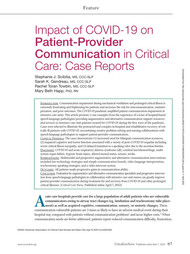
|
Abstract:
Introduction: Communication impairment during mechanical ventilation and prolonged critical illness is extremely frustrating and frightening for patients and increases the risk for miscommunication, misinterpretation, and poor outcomes. The COVID-19 pandemic amplified patient communication impairment in intensive care units. This article presents 3 case examples from the experience of a team of hospital-based speech-language pathologists providing augmentative and alternative communication support resources and services to intensive care unit patients treated for COVID-19 during the first wave of the pandemic. Cases were selected to illustrate the protracted and complex in-hospital and rehabilitative recovery of critically ill patients with COVID-19, necessitating creative problem-solving and nursing collaborations with speech-language pathologists to support patient-provider communication. Clinical Findings: The cases demonstrate (1) increased need for bilingual communication resources, (2) impaired cognitive and motor function associated with a variety of post–COVID-19 sequelae including severe critical illness myopathy, and (3) delayed transition to a speaking valve due to the secretion burden. Diagnoses: COVID-19 and acute respiratory distress syndrome (all), cerebral microhemorrhage, multisystem organ failure, hypoxic brain injury, altered mental status, seizure, stroke. Interventions: Multimodal and progressive augmentative and alternative communication interventions included low-technology strategies and simple communication boards, video language interpretation, tracheostomy speaking strategies, and a video intercom system. Outcomes: All patients made progressive gains in communication ability. Conclusion: Evaluation by augmentative and alternative communication specialists and progressive intervention from speech-language pathologists in collaboration with intensive care unit nurses can greatly improve patient-provider communication during treatment for and recovery from COVID-19 and other prolonged critical illnesses. (Critical Care Nurse. Published online April 7, 2022) Scibilia, S. J., Gendreau, S. K., Towbin, R. T., & Happ, M. B. (2022). Impact of COVID-19 on Patient-Provider Communication in Critical Care: Case Reports. Critical Care Nurse, e1-e9. https://doi.org/10.4037/ccn2022405 Link:
|
|
Ensuring communication access for all during the COVID-19 pandemic and beyond: supporting patients, providers, and caregivers in hospitals |
2021 article by Altschuler, Santiago, and Gormley found at https://www.tandfonline.com/doi/abs/10.1080/07434618.2021.1956584?journalCode=iaac20
Abstract The COVID-19 pandemic has revealed substantial gaps in communication access for patients across hospital settings. With the rise in positive cases globally, the need for communication enhancement strategies, including augmentative and alternative communication (AAC), has emerged as a critical need. Many resources exist that describe AAC assessment and intervention processes in the acute care setting; however, AAC service provision in the COVID-19 pandemic is fraught with many unanticipated challenges. Patients, providers, and caregivers have encountered significant communication strain both at the bedside and beyond hospital walls, resulting in a communication crisis induced by many COVID-19 related variables. This article describes the sequelae of symptoms a person with COVID-19 may experience, progression of communication needs, and evidence-based solutions to supporting communication access. Barriers related to the COVID-19 pandemic are outlined (e.g., evolving infection control practices, personal protective equipment requirements, visitor policies, and more) along with response recommendations to support communication enhancement efforts for people with and without COVID-19 benefiting from access to AAC. Altschuler, T., Santiago, R., & Gormley, J. (2021). Ensuring communication access for all during the COVID-19 pandemic and beyond: supporting patients, providers, and caregivers in hospitals. Augmentative and Alternative Communication, 1-13. https://doi.org/10.1080/07434618.2021.1956584 |
|
VidaTalk™ patient communication application “opened up” communication between nonvocal ICU patients and their family |
2021 article by Shin, Happ, and Tate found at https://www.sciencedirect.com/science/article/pii/S0964339721000641?dgcid=rss_sd_all
Abstract Objectives To explore family members' perceptions of an electronic communication application, VidaTalk™, their communication experience, and emotional reactions to communication with mechanically ventilated patients in the intensive care units. Research methodology/design Qualitative phase of a mixed-methods study nested within a randomised controlled trial. Family members in the intervention group received the VidaTalk™ app as a communication aid during their intensive care stay. Seven family members participated in 18 semi-structured email interviews after discharge between May and December 2018. Interviews were analysed using qualitative content analysis. Setting Families were recruited in multiple intensive care units located in one university hospital. Main outcome measures Communication experience with the VidaTalk™ and emotions while communicating with the patient. Basic qualitative description and constant comparative techniques were used to code and analyse the text using ATLAS_ti (Version 7.5.18). Findings The VidaTalk™ opened up family-patient communication by allowing clear communication and expanding communication content. Family members felt happy and thankful to communicate with the patient. They also expressed feelings of relief and less frustration and less stress while communicating with the patient.? On the other hand, the patient's ability to express their worries or anxiety sometimes made families feel sad or distressed. Conclusion The VidaTalk™ was helpful for family-patient communication. The VidaTalk™ may help families reduce psychological distress. However, ?expanded communication with critically ill patients may cause other negative feelings. Shin, J., Happ, MB., Tate, J. VidaTalk™ communication application “opened up” communication between nonvocal ICU patients and their family caregivers. Intensive and Critical Care Nursing 2021 Oct;66:103075. doi: 10.1016/j.iccn.2021.103075. available on line ahead of print Epub 2021 Jun 12. |
|
Giving voice: Nures-patient communication in the ICU |
2021 article by Mary Beth Happ found at: https://pubmed.ncbi.nlm.nih.gov/34195776/
Communication is the essence of the nurse-patient relationship. The critical care nurse's role in facilitating patient communication and enabling communication between patients and their families has never been more important or poignant than during the COVID-19 pandemic. We have witnessed tremendous examples of resourceful, caring nurses serving as the primary communication partner and support for isolated seriously ill patients during this pandemic. However, evidence-based tools and techniques for assisting awake, communication-impaired, seriously ill patients to communicate are not yet systematically applied across all settings. Missed communication or misinterpretation of patients' messages induces panic and fear in patients receiving mechanical ventilation and can have serious deleterious consequences. This lecture presents a 23-year program of research in developing and testing combination interventions (eg, training, tailored assessment, and tools) for best practice in facilitating patient communication during critical illness. Evidence from related nursing and inter pro fessional research is also included. Guidance for unit-based assessment, tailoring, and implementation of evidence-based patient communication protocols also is provided. (C) 2021 American Association of Critical-Care Nurses. Happ MB. (2021). Giving voice: Nurse-patient communication in the ICU. Am J Crit Care; 30(4):256-265. doi: 10.4037/ajcc2021666. |
|
Being heard - Supporting person-centered communication in paediatric care using augmentative and alternative communication as universal design: A position paper. |
2021 article by Thunberg et al. found at: https://pubmed.ncbi.nlm.nih.gov/34076320/
Abstract: Person-centered care, with its central focus on the patient in partnership with healthcare practitioners, is considered to be the contemporary gold standard of care. This type of care implies effective communication from and by both the patient and the healthcare practitioner. This is often problematic in the case of the paediatric population, because of the many communicative challenges that may arise due to the child's developmental level, illness and distress, linguistic competency and disabilities. The principle of universal design put forth in conventions and legislation means that the design of products and services should be usable by all people, to the greatest extent possible. Augmentative and alternative communication encompasses strategies, for example pictures and apps, that are typically used with people with communication disability. In this position paper, we argue for the universal use of augmentative and alternative communication to support person-centred communication and care for children, regardless of age or potential disability. Clinical examples are shared from three different paediatric care settings where pictorial supports were applied universally. Interviews were conducted with children and adolescents (with and without disabilities), parents and healthcare practitioners, and the principles of universal design were used as a framework to demonstrate how person-centred communication is supported in paediatric care. Thunberg, G., Johnson, E., Bornman, J., Öhlén, J. & Nilsson, S. (2021). Being heard – Supporting person-centred communication in paediatric care using augmentative and alternative communication as universal design: A position paper. Nursing Inquiry. Early Online. doi: 10.1111/nin.12426 |
|
Promoting System Change for Communication Access in Acute Care Hospitals 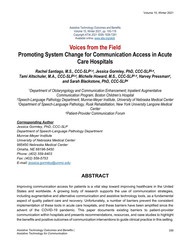
|
Abstract: Improving communication access for patients is a vital step toward improving healthcare in the United States and worldwide. A growing body of research supports the use of communication strategies, including augmentative and alternative communication and assistive technology tools, as a fundamental aspect of quality patient care and recovery. Unfortunately, a number of barriers prevent the consistent implementation of these tools in acute care hospitals, and these barriers have been amplified since the advent of the COVID-19 pandemic. This paper documents existing barriers to patient-provider communication within hospitals and presents recommendations, resources, and case studies to highlight the benefits and positive outcomes of communication interventions to guide clinical practice in this setting. Specifically, recommendations are presented across a number of systems that impact healthcare delivery including: (a) healthcare policies and regulations, (b) healthcare providers, (c) hospital units and departments, and (d) patients and families.
View the open access article at: https://www.atia.org/wp-content/uploads/2021/03/V15_Santiago_etal.pdf |
|
Disaster Preparedness and People with Disabilities 
|
Download:
|
|
Long Awaited Book on Patient Provider Communication Released 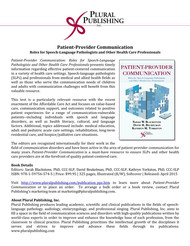
|
Patient-Provider Communication: Roles for Speech-Language Pathologists and Other Health Care Professionals
Download:
|


International PPC Newsletters Archive
Please choose an issue below. |
||
 |
||