Patient Stories
Enabling ICU Communication During COVID-19
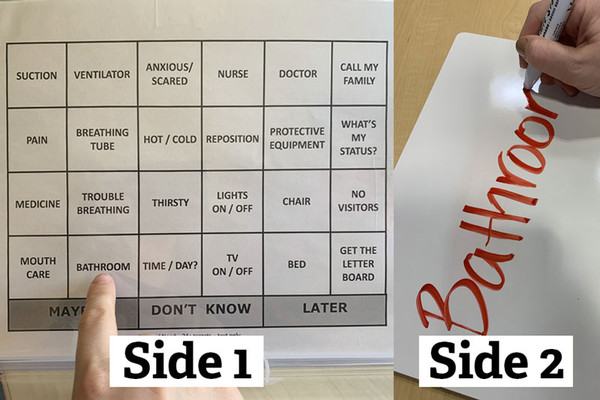
Last year, a 70-year-old woman was diagnosed with a mass on her neck, which restricted her ability to swallow and manage her secretions. A tracheostomy and a percutaneous endoscopic gastrostomy, or PEG tube were placed, requiring her to use a speaking valve to communicate. She also began chemotherapy.
Recently, during chemotherapy treatment, she unexpectedly developed respiratory failure and was transferred to the ICU. She tested positive for Influenza A and was under investigation for COVID-19.
Her rapid decline required ventilator support without adjustments for ventilator-assisted speech. Further, as her dysphagia persisted, she was deemed not ready for a bedside swallow assessment. This type of escalated respiratory care, which can involve intubation or ventilation and thus the inability to speak, is also seen among patients severely affected by COVID-19. (And patients removed from sedation or ventilation might present with cognitive issues.)
In this case, a speech-language pathologist was charged with finding her a communication strategy. Massachusetts General Hospital's COVID-19 efforts to limit patient-provider contact meant the SLP couldn't enter the patient's room. These restrictions posed significant challenges and required a resourceful plan.
The SLP interviewed the patient's spouse and nurse multiple times by phone. The spouse described their wife always wanting a blanket, the TV on at night, and keeping her glasses nearby. The nurse said the patient wrote a message, which led the SLP to ask further questions: Was the writing legible? How long were the messages? What position did the patient need to be in to write? The nurse eagerly engaged in problem-solving, which helped the SLP devise communication tools and strategies.
A tailored AAC plan
The SLP provided the nurse with recommendations and watched their implementation from the patient's anteroom. For example, the SLP suggested that if the patient struggles to hold a pen, to try a marker. This allowed the SLP to establish a temporary plan for an alternative means of communication. For longer messages, the patient wrote with marker on a dry-erase board. Taped to the back of the board was a list of short phrases the patient could point to. The SLP tailored the list to the patient's needs, with input from the nurse and spouse.
But COVID-19 restrictions required further action. The nurse told the SLP she noticed the patient starting to withdraw. The no-visitors' policy left the patient—and many others—feeling isolated. To improve her motivation and mood, they set up daily video calls with her spouse.
The nurse also noticed PPE interfering with the patient's ability to read lips and interpret facial expressions, both vital to comprehension because of the patient's hearing loss. These further complications led the SLP to create a bedside sign advising health care providers to make sure the patient's hearing aids were on, to speak loudly and distinctly, and to confirm the patient's understanding.
What we contribute
Despite numerous restrictions, the SLP found ways to advocate for the patient and facilitate efficient communication between the patient and her providers. This included enhanced care coordination by increasing in-person collaboration and a greater reliance on "behind-the-scenes" or non-face-to-face interactations. We know it's a basic human right for people to be able communicate, from everyday needs ("I have to go to the bathroom") to complex conversations about their illness. Most of these patients are also separated from family who would ordinarily serve as advocates.
Patients considered communication-vulnerable are three times more likely to experience a preventable adverse medical event. SLPs, in partnership with nurses, play a critical role in facilitating communication as they work the front lines of patient care. We are uniquely positioned to assess and develop appropriate communication tools for successful patient-provider interactions.
Timely resources
With resources in short supply and stress levels high, an interprofessional group from across the country assembled through the Patient-Provider Communication forum (PPC) to create free patient communication tools for hospitals and health care workers. The suite includes downloadable COVID-relevant communication boards that support patients of different ages, abilities, and languages in critical acute medical settings. Instructions are designed for providers with all levels of experience and these "no-tech" resources can be disposed of after use. On the site you'll also find additional case studies, strategies for communicating while using masks and face shields, and a variety of bilingual tools.
More resources and related articles:
Spotlight on ASHA Special Interest Group 12, Augmentative and Alternative Communication
Simulating Patient Communication Strategies
'Not Just Dots On a Map': SLPs Speak Their Truth From the COVID-19 Battlefront
Stephanie Scibilia, MS, CCC-SLP, a clinician working with adult inpatients at Massachusetts General Hospital, is a collaborator on the COVID-19-AAC taskforce. sscibilia@mgh.harvard.edu
Adrianna Doyle, MS, CCC-SLP, also contributed to this post.
The task force also includes Tami Altschuler, MA, CCC-SLP; Sarah Gendreau, MS, CCC-SLP; Jessica Gormley, PhD, CCC-SLP; Mary Beth Happ, PhD, RN, FAAN, FGSA; Richard Hurtig, PhD, SLP; Sarah Marshall, MA, CCC-SLP; Rachel Santiago, MS, CCC-SLP; Judith Tate, PhD, RN; Rachel Toran Towbin, MS, CCC-SLP; Sarah Blackstone, PhD, CCC-SLP; and Harvey Pressman.